
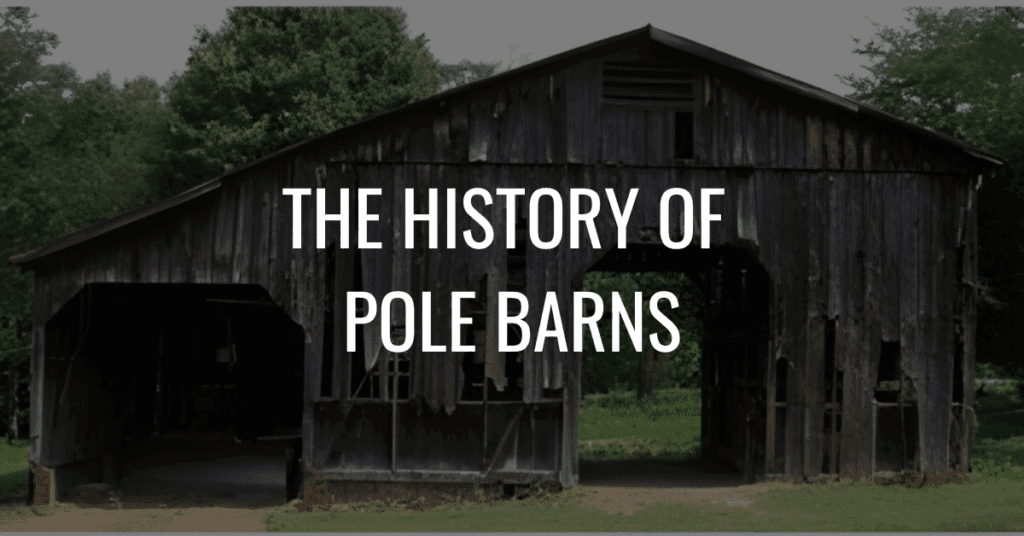
Pole barns – simple structures supported by posts in the ground – have a longer history than you might think. From ancient civilizations using wooden poles for shelters to modern post-frame construction methods, the history of pole barns is a story of practicality and innovation. Below we’ll explore the origins of pole barns, their development through the 20th century and some surprising historical tidbits along the way.
Early Origins: Posts in the Ground Across Cultures
A historic French colonial house (built 1792) in Ste. Geneviève, Missouri, constructed with vertical logs set directly into the earth – an early example of post-in-ground building.

The concept of building with poles or posts embedded in the ground dates back thousands of years. Many prehistoric and indigenous structures around the world used upright wooden posts sunk into postholes to support roofs (1). This “earthfast” or post-in-ground style of construction was common from the Neolithic period onward (2) and was often used for houses expected to last only a decade or two (1).
For example, French colonists in North America built poteaux-en-terre (“posts in earth”) homes using vertical logs planted in the soil – a few of these 18th-century structures still survive in Missouri (3). In Japan, a similar method called hottate-bashira (“embedded pillar”) was used in vernacular buildings up to the 1700s (1). Early American settlers also used earthfast building for quick shelters and barns, especially in the 1600s–1800s, though such structures were impermanent and prone to rot (4).
By the 19th century, builders began looking for ways to make pole-supported buildings more durable. Innovations like stone footings and treated wood were still in their infancy, but the idea of using readily available utility poles was already emerging. Notably, as early as 1889 an Iowa farming journal described a “Midwestern hay barn” design that could use full-length telephone poles as the upright supports (5). This forward-thinking concept – coming at a time when telephone lines were spreading across rural America – foreshadowed the revolution in farm building that would arrive decades later driven largely by economic forces.
The 1930s: The Birth of the American Pole Barn
The Great Depression and the Dust Bowl of the 1930s created a desperate need for affordable, quick-to-build farm structures. Traditional wooden barns with heavy timber frames were expensive and time-consuming to put up when farmers’ budgets were stretched to the limit.
The solution came in the form of the modern pole barn, a simple but effective adaptation of post-frame construction that farmers could build with minimal materials. During this era, old utility poles (like used telephone poles) were cheap and plentiful (5). Farmers bought these poles, stuck them in the ground, and attached lightweight roofs and wall sidings – often corrugated metal sheets – to create instant barns. These early structures were literally called telephone pole barns, a name that soon was shortened to just pole barns.
H. Howard Doane, an agricultural consultant from St. Louis and founder of Doane Agricultural Service (DAS), is credited with formalizing the pole barn concept in 1930 (6). Doane believed traditional wooden barns on farms could not be economically justified in hard times, which was evident. In 1930, he pioneered building barns that combined wooden poles with metal roofing – essentially a new construction method optimized for economy and function.
Instead of expensive timber frames on concrete foundations, Doane’s barns used round wood poles (often cedar) as the primary supports, spaced around the perimeter and set into holes in the ground. He put rafters or trusses on top of the poles, with 1-inch boards or purlins between them to support a galvanized steel roof and siding. This stripped-down design eliminated much of the lumber and labor of traditional barns, cutting costs big time.
A rustic old American barn showing the simple post and beam framework. Early pole barns of the 1930s were built by embedding round wooden poles in the ground and attaching a roof and siding, using far fewer materials than traditional barns.

Doane’s early pole barns proved that farmers could build a barn fast and cheap. The simplicity of using widely spaced poles for structure meant construction required less skill – and fewer expensive materials – than a timber-frame. As the idea spread, farmers across the country started copying the method. Even without plans, many just used the formula of “four poles and a roof” to shelter equipment, hay and livestock. By the late 1930s, pole barns were in American agriculture. But those first-generation pole barns had drawbacks.
The wooden poles were often un-treated and in direct contact with soil, making them prone to rot and insect damage. In fact, those old telephone poles had often been discarded because they were starting to rot. So an early pole barn might only last around 8–10 years before the buried poles deteriorated, especially in wet climates. But it was better than no barn at all when you needed to protect your livelihood.
1940s–1950s: Wartime Innovations and Post-Frame Progress
As the 1930s became the 1940s, several key innovations arrived to address the weaknesses of those first pole barns. The mid-1930s saw experiments with improving the wood poles’ durability. Doane’s farm manager, Bernon G. Perkins, refined the pole-barn concept by switching from raw cedar poles to creosote-treated poles when red cedar became scarce (7). Creosote (a heavy oil preservative used on railroad ties) extended the life of wooden posts by protecting them from rot. By the late 1930s and early 1940s, creosoted poles became standard, giving a pole barn a life of 20 years or more instead of under a decade.
Another Perkins innovation was to use 2×4 lumber as purlins (roof stringers) placed on edge and spaced a few feet apart, which allowed the roof rafters or trusses to be spaced much farther apart (4–12 feet) than in earlier designs (7). This meant fewer trusses or rafters were needed to support the roof, without sacrificing strength – a clever way to minimize material while still handling wind and snow loads. Perkins even overlapped purlin boards in place without cutting them to exact lengths, to save on labor and lumber waste.
Drawings from U.S. Patent US2641988A, a pole building for grain drying invented by Bernon G. Perkins and assigned to Howard Doane’s Company, DAS. Doane distributed his plans freely to encourage construction of pole barns.


World War II accelerated the adoption of pole barns. With wartime resource shortages, the U.S. government in the early 1940s capped spending on new farm buildings to $1,500 per structure (6). Pole construction was practically the only way to build a barn under that tight budget, since it eliminated up to two-thirds of the lumber that a comparable traditional barn would require. Doane’s pole-barn method was explicitly promoted as a patriotic, economical solution for farmers during the war.
Many agricultural colleges and the USDA Extension Service began circulating pole barn plans and instructions to farmers. The result was a boom in pole barns built in the 1940s, used as everything from machine sheds to corn cribs, hog shelters, and hay storage (8). These wartime-era pole barns often had low-pitched roofs and open sides or sliding doors, giving them a utilitarian shed-like appearance rather than the lofty haylofts of old wooden barns (6).

An excellent surviving example is the Silver Spur Stables barn in Glendale, California – built in 1939 as a horse barn, it features the telltale tall posts, low gable roof, and economical design typical of Great Depression and WWII-era pole barns (9). Remarkably, that barn remained in active use until 2024, over 80 years later – a testament to how the introduction of treated posts gave pole barns much greater longevity.
Two mid-century technological developments truly transformed pole barns from temporary fixes into long-term building systems. First was the widespread availability of pressure-treated lumber after the war (applying chemical preservatives like CCA and ACC under pressure, even more effective than surface creosote painting). By the 1950s, farmers could obtain factory-treated round poles or squared posts that were rated for decades of ground contact (10). Embedding these treated posts deep below the frost line took the place of a traditional concrete foundation, carrying the building loads directly into the soil with surprisingly good stability.
The second development was the advent of lightweight metal sheeting – large galvanized steel panels for roofs and walls that could span several feet between supports. Because these steel panels are rigid when fastened to purlins or girts, they act like shear bracing for the building. Engineers eventually realized that the metal skin and the pole frame work together as a system (known as diaphragm design), allowing pole barns to withstand wind and snow loads with fewer posts than old timber barns (11). In short, the post-war era saw the pole barn mature into a viable, long-lived structural system rather than just a make-do shed.
To summarize some key innovations that made modern pole barns possible:
- Wood Preservation: The use of pressure-treated or creosote-coated poles solved the age-old problem of buried posts rotting, extending post lifespan from ~10 years to multiple decades.
- Metal Cladding: Affordable corrugated metal roofing and siding became available, allowing builders to cover large spans cheaply and to rely on the sheathing for structural support (transferring loads to endwalls).
- Trusses & Span: By the 1950s, engineered metal plate-connected wood trusses appeared, which enabled pole barns to span much wider. Barn widths jumped from around 20–30 feet to as much as 80+ feet thanks to widely spaced trusses and purlins (12). This made pole buildings practical for large machinery sheds, arenas, and more.
- Foundations Simplified: Deep-set poles replaced expensive concrete foundations. A pole barn only needed concrete footings around each post, or even just compacted soil backfill, drastically cutting foundation costs.
The 1960s and Beyond: From Farm Buildings to Barndominiums
By the 1960s, the pole barn had fully entered mainstream use and even gained a new name: post-frame construction. As the industry moved away from using actual round utility poles toward straight, square posts for improved strength, the term “pole barn” gradually gave way to post-frame building in professional circles (7). During the 1960s, pole buildings spread beyond agriculture into commercial and civic applications. It became common to see post-frame structures serving as county fair pavilions, warehouses, fire stations, and even churches, especially in rural areas – wherever a large, economical single-story building was needed.
Early adopters in the academic and engineering community were initially skeptical that slender posts in earth could support large buildings safely (7). But as post-frame buildings survived high winds and heavy snows, testing proved they often performed better per pound of material than traditional stick-framing. The diaphragm action of the nailed steel panels and the flexibility of the post foundations gave these buildings a resilience that wasn’t fully understood at first, prompting new research into their structural behavior. By the late 1970s, post-frame construction had gained approval in building codes across the U.S., firmly establishing itself as a legitimate method.
Several improvements in the 1970s–1980s era further enhanced post-frame building capabilities. One major change was the shift from using single large posts to laminated columns – for example, nailing or gluing together three 2×6 or 2×8 lumber pieces to form a durable post. These glulam or built-up posts are less prone to warping and can be made in almost any length or cross-section needed. Combined with advances in wood treatment (like CCA pressure treatment and later safer formulas), by the 1980s many post manufacturers were offering multi-decade warranties on treated laminated columns. In other words, the support posts of modern pole barns became effectively permanent. This longevity encouraged people to invest more into their pole buildings, adding concrete floors, insulation, and other amenities that might have seemed pointless in the disposable pole sheds of earlier decades.
Another trend was the continual expansion of uses for pole buildings. While mid-century pole barns were mostly farm outbuildings, by the 1980s the concept had been adapted to residential and mixed-use designs. The term “barndominium” – a portmanteau of barn and condominium – arose in 1989 (13) to describe a pole-barn structure finished as a home or a combination house-and-workshop.
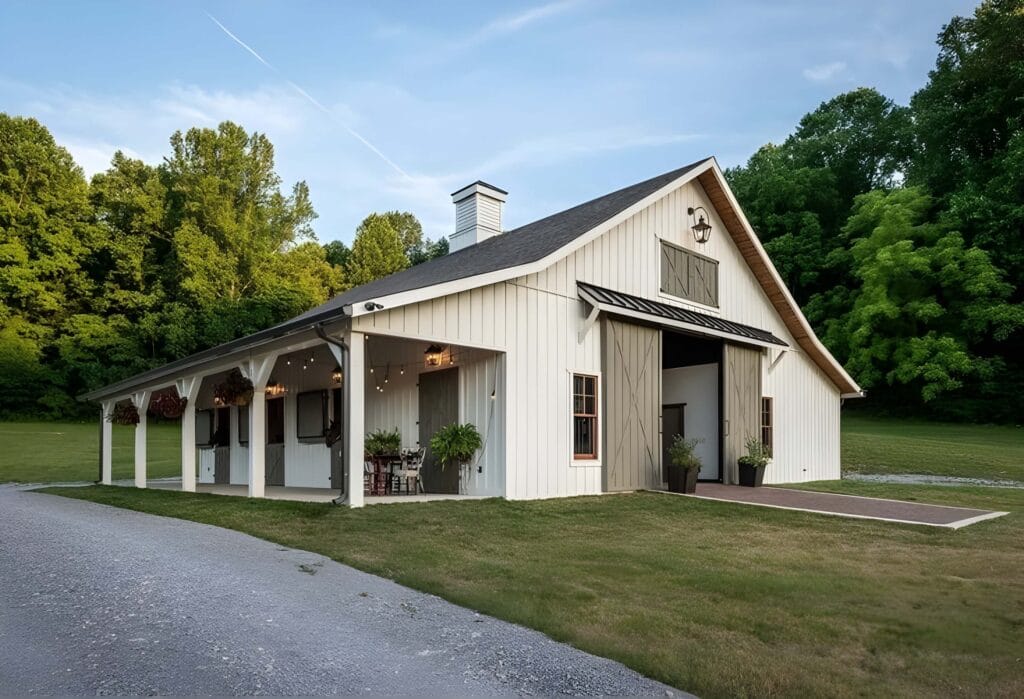
What began as a utilitarian idea (e.g. a farmer putting living quarters in one end of a pole barn) turned into an architectural movement for open-plan, rustic-inspired homes. By the 1980s and 90s, some homeowners began choosing pole barn houses for their affordability and flexibility, often constructing large country homes that double as garages or hobby shops under the same roof. This era also saw the post-frame technique used for municipal buildings, schools, office complexes, and retail stores, especially in areas where wooden construction was preferred over expensive steel or masonry. The style and engineering of pole buildings also evolved – no longer just simple rectangles, post-frame buildings could incorporate stylish façades, gambrel or monitor roofs, mezzanines, and more.
Today, pole barns (or post-frame buildings) are everywhere in North America. The pole barn has truly shed its image as a makeshift shed and is now just as likely to be a polished suburban garage, a horse arena, or a modern country home. The economic advantages remain a big draw – post-frame structures use fewer materials and can go up faster than conventional buildings. In fact, the global post-frame construction market was estimated at about $8.2 billion in 2024 and was projected to grow to nearly $13.7 billion by 2033 as demand for residential and commercial post-frame projects keeps rising (14). With modern advancements like pre-engineered metal connector plates, computer-aided design, and even prefab pole barn kits, these buildings continue to push into new territory. Yet, at their core, they remain the same as they were in the 1930s: simplify construction by using widely spaced posts anchored in the earth, and save money without sacrificing utility.
It’s worth noting that the term “pole barn” itself has become part of popular culture – an iconic symbol of rural ingenuity. Many people fondly picture the classic red pole barn on a farm (often unaware of the engineering that makes it stand). Organizations like the National Frame Building Association (formed in 1969) continue to advance the technology, so pole barns meet modern safety standards and innovations. From a historical perspective, what began as a Great Depression workaround has evolved into a highly optimized construction method. The legacy of pioneers like Howard Doane and Bernon Perkins lives on every time someone builds a new pole barn or post-frame home on their property, enjoying the same benefits of affordability, versatility, and speed that pole barns offered nearly a century ago.
Bonus: Why Are So Many Barns Painted Red?
You’ll notice red barns all over the countryside. This tradition predates the pole barn era and goes back to colonial times, but it’s a fun historical footnote often associated with American barns. The classic barn red color wasn’t chosen for looks – it was about function and thrift.

Early farmers would seal their wooden barns with oil, usually linseed oil from flax seeds, to protect the wood from the elements. Linseed oil has an orange-brown color on its own, but farmers discovered they could create a more effective, longer-lasting sealant by mixing in other ingredients. One key addition was rust (iron oxide), which was abundant on farms and (importantly) is toxic to fungi like mold and moss.
By mixing rusty milk or whey (or later, red iron oxide pigment) into their oil, farmers produced a cheap wood preservative that happened to dry to a bright red-orange color (15). Thus the iconic “barn red” was born out of necessity – the rust-enhanced paint protected barns from the weather and gave them their distinctive color. Generations of American farmers continued this tradition and today many modern pole barn owners choose red metal siding as a nod to that history.
Early Pole Barns and Their Legacy
Considering their humble beginnings, it’s amazing how many early pole barns lasted long enough to become historic landmarks in their own right. We’ve already mentioned the 1939 Silver Spur Stables barn (9), which shows the durability post-frame construction achieved once wood preservation was introduced. Another famous example is the series of prototype pole barns built by Doane’s Agricultural Service in the early 1930s in Missouri – while those specific buildings may not all still exist, they were so influential that by the 1960s nearly every new farm building in some areas was being built post-frame.

Agricultural historians note that by the post-war years, most new barns and implement sheds on American farms were pole barns, because of the cost savings and the success of county extension programs in promoting the designs. That’s a quick transformation in rural architecture: within a few decades the pole barn went from an experiment to the norm for farm construction.
Looking beyond the U.S., it’s interesting to see that the pole-building approach has analogues around the world (many predating the American pole barn). In addition to the French and Japanese methods mentioned earlier, many traditional societies built open-air barns and shelters on posts to store crops – for example, Native Hawaiian hale structures and some African yam barns used elevated post frames to keep stored food dry and safe from pests. These global parallels show that the idea of “build it on poles” arises whenever people need a quick, economical shelter. What sets the American pole barn apart is how it combined this timeless idea with 20th-century industrial materials – using telephone poles and factory-made steel roofing – to meet a specific historical moment’s needs.
In retrospect, the history of pole barns is a perfect example of vernacular innovation. Farmers in hard times took an old idea (posts in the ground), added some creativity (reusing modern materials), and created a new farm building. The pole barn continued to evolve through collective improvement: from Doane and Perkins’ tweaks, to university engineering tests that legitimized post-frame construction, to today’s professional barn builders who can raise a pole barn in a matter of days. As we enjoy modern pole barns – whether it’s a cozy barndominium home or a big equipment shed – we’re enjoying the result of many decades of incremental progress.
In summary, pole barns have gone from ancient roots (holes in the ground with poles for shelter) to a modern construction machine. They rose to popularity in the lean years of the 1930s when America needed practical solutions, and they’ve only gotten more robust and versatile since. Next time you see a rusty old barn or a new post-frame building, you’ll know that behind its simple exterior is a long history of resourcefulness and adaptation. The story of pole barns is really about building with less – an idea that will likely be framing our buildings for many years to come.
Sources:
- Wikipedia – Post in ground (Earthfast) Construction
- Journal of Neolithic Archaeology – Mansion on the Hill – A Monumental Late Neolithic House at Vinge, Zealand, Denmark
- National Park Service – Bauvais-Amoureux House at Ste. Geneviève National Historical Park
- Vernacular Architecture Forum – Impermanent Architecture in a Less Permanent Town
- Historic Context Study: Minnesota Farms 1820–1960 – Development of Pole Barns
- National Park Service – National Register of Historic Places Multiple Property Documentation Form
- NFBA – Introduction to Post-Frame Buildings
- U.S. Department of Agriculture – Plans Of Farm Buildings For Southern States (1940)
- Silver Spur Stables Historical Assessment (Glendale, CA)
- American Wood-Preservers’ Association – Looking Back at 75 Years of Research in Wood Preservation at the U.S. Forest Products Laboratory
- Transactions of the ASAE – Post-Frame Design Using Diaphragm Theory
- Canadian Wood Council – Wood Roof Trusses: Strength, Economy, Versatility
- Wikipedia – Barndominium
- Growth Market Reports – Post Frame Building Market Research Report
- Library of Congress Blogs – A Closer Look: Why Barns Are Red
P.S. If you’re looking to build a quality pole barn or barndominium in Northern Utah or Southern Idaho, get in touch.